



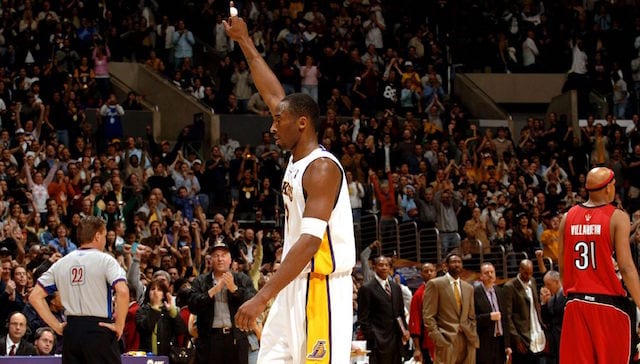
A few days after Bam Adebayo’s 83 points against the Washington Wizards, the debate has centered on how his night stacks up against Kobe Bryant’s 81 for the Los Angeles Lakers in 2006. Both performances sit in rare company, behind only Wilt Chamberlain’s 100, yet the games looked and felt very different.
With emotions cooling and more details available, it is possible to compare the two nights on fair terms. Context, game script, efficiency, and role all matter when judging where these games sit in history. Fans, analysts, and even the NBA betting community have tried to balance respect for Adebayo’s achievement with recognition of what made Bryant’s 81 unique.
Two Historic Nights, Two Very Different Games
Kobe Bryant’s 81 came in a game the Lakers needed to save. On January 22, 2006, at Staples Center, the Lakers trailed the Toronto Raptors by 18 in the third quarter and were booed off the floor at halftime. Bryant’s eruption flipped the game and turned a likely loss into a 122 104 win.
Bam Adebayo’s 83 on March 10, 2026, came in a very different setting. Miami controlled the game from early on against a struggling Wizards team in a 150 129 win. The Heat were not digging out of a massive deficit. Adebayo poured in points while Miami maintained a comfortable cushion for most of the second half.
Kobe needed to score almost every trip to rescue the Lakers. He played about 42 minutes, finished with 81 points on 28 of 46 shooting, 7 of 13 from three, and 18 of 20 at the line, and added 6 rebounds, 2 assists, 3 steals, and a block. The Lakers’ comeback, and their energy, flowed directly from his scoring binge.
Adebayo also logged roughly 42 minutes. He finished with 83 points on 20 of 43 from the field, 7 of 22 from three, and a record-breaking 36 of 43 at the free throw line, plus 9 rebounds and 3 assists. His scoring was more spread out and whistle-driven, with Miami rarely in serious danger of losing.
Era, Style, And Usage Matter
Bryant’s 81 came in a slower, midrange heavy era. The 2005 06 Lakers averaged around 97 points per game. He finished that season at 35.4 points per game, so his 81 was about 2.3 times his season average. Offenses relied on isolation, midrange jumpers, and post play, and spacing was far tighter.
Adebayo’s 83 landed in a league where teams average around 112 points per game and three pointers fly from everywhere. He entered this season as a 20-point-per-game scorer, meaning his 83 is roughly 3.7 times his usual output. His performance stands out even more against his typical role, especially given that he is not viewed as an elite perimeter scorer.
That contrast cuts both ways. Kobe’s night came in an environment less built for monster scoring totals, against a set defense that knew exactly who was taking the shots. Adebayo exploded in a faster, more offensive friendly league, but also from a starting point as more of a defensive anchor and offensive hub than a pure scorer.
Scoring Methods And Efficiency
Bryant’s game was a clinic in tough shot-making. He attacked from all three levels, repeatedly punished single coverage, and thrived in high-pressure possessions. His 60.9 percent from the field and 53.8 percent from three are elite numbers, given the volume and shot difficulty. Many of his points came in the second half as Toronto adjusted and still could not slow him.
Adebayo’s efficiency profile is more complicated. His 46.5 percent overall and 31.8 percent from three are solid but not lights-out for such a high-usage night. The difference came at the free-throw line. He hit 36 of 43, setting single-game records for both makes and attempts. Game flow, defensive strategies, and whistle tendencies all contributed to that parade to the line.
Both performances demanded stamina and mental focus. Kobe carried the offense through a comeback. Adebayo kept hunting points late in a game that was already tilting heavily toward Miami.
Team Needs Versus Record Chasing
The heart of the debate is not whether 83 points are impressive. It is how much the game demanded it, and when it turned into a chase.
In 2006, the Lakers needed Bryant on the floor. They trailed by double digits in the third quarter, and his surge flipped the scoreboard. Even when the outcome looked safer late, the Raptors never completely went away. Kobe’s minutes and shots made sense within the context of trying to win.
Against Washington, Miami never faced that kind of pressure. The Heat built and maintained a big lead in the second half. Adebayo stayed on the floor deep into a blowout as teammates repeatedly looked for him. Head coach Erik Spoelstra chose to ride the hot hand rather than pull him early, as most coaches do when a game is out of reach.
That is where discussions of “ethical basketball” enter. Traditionally, if a star has done enough to secure a blowout win, he sits. Coaches rest players, avoid extra injury risk, and do not pour it on an overmatched opponent. Record chasing, especially in garbage time, can rub some players and fans the wrong way.
At the same time, records are part of sports. When a player catches fire and history is within reach, coaches often weigh the risk, the locker room reaction, and the significance of the moment. In Miami’s case, they clearly decided that letting Adebayo chase 83 was worth it for the team, the player, and the franchise.
Many Others Had The Same Opportunity
Part of what makes both games special is how many great scorers have come close, only to sit early or see the game situation shift.
Kobe Bryant scored 62 points in three quarters against the Dallas Mavericks in 2005. He did not play the fourth in a blowout win. LeBron James had 61 for the Heat against Charlotte in 2014, with time left on the clock, but exited with the game in hand. Klay Thompson dropped 60 in 29 minutes against Indiana in 2016 and never saw the floor in the fourth quarter.
Devin Booker scored 70 in a loss to Boston when Phoenix leaned into the record chase. Damian Lillard hit 71 against Houston, Luka Doncic has had multiple 70-plus outbursts, Joel Embiid reached 70 against San Antonio, and Stephen Curry and James Harden have both had nights in the low 60s. In almost every case, coaches either pulled their stars in blowouts or managed minutes with the bigger picture in mind.
That history is why Adebayo’s 83 sparks mixed reactions. Players and fans have seen coaches stop similar explosions short in the name of rest, sportsmanship, or long-term thinking. Miami chose the other path and let a star keep going in a game that was already decided.
Finding A Fair Middle Ground
A fair comparison gives both performances their due. Kobe Bryant’s 81 remains one of the most complete, context-rich scoring explosions ever. It came in a slower era, in a comeback win, with elite efficiency, and under real scoreboard pressure. It captured the essence of his role as a franchise player who had to do everything to help his team win.
Bam Adebayo’s 83 is historic in a different way. It came from a player not known primarily as a scorer, featured a modern mix of threes and a remarkable free-throw volume, and pushed the boundaries of what a big man can do in today’s game. It also required a coaching decision to keep him in during a blowout and a collective focus on breaking a record held by a Lakers legend.
Bryant’s 81 still stands as the cleaner blend of necessity, efficiency, and competitive stakes. Adebayo’s 83 sits as an extraordinary statistical achievement, aided by modern pace and a looser approach to record chasing. Both belong near the top of the all-time list, but for very different reasons.
As the league continues to evolve, pace increases, spacing improves, and stars gain more skill, someone will likely threaten both numbers again. The next time it happens, the same questions will return: how much should context matter, and where is the line between chasing history and respecting the game?