


The Los Angeles Lakers have reached the final stretch of the 2025-26 season with a clearer identity, a defined hierarchy, and a realistic but challenging path in the Western Conference. They sit in the upper half of the West standings, built around the star duo of Luka Dončić and LeBron James, with Austin Reaves and a deep rotation providing support on both ends of the floor. This version of the Lakers is deeper, more versatile, and less reliant on one player than in recent years, but still searching for a consistent closing formula against top-tier opponents.
That balance of upside and volatility is reflected in their current futures price. ScoreBet lists the Lakers in the middle tier of contenders to win the 2026 NBA championship, behind the clear favorites but firmly in the group of teams oddsmakers believe can put together a run if health and matchups break their way. Their number reflects respect for their star power, skepticism about their occasional defensive lapses and late-game execution, and an acknowledgment of how crowded the top of the conference has become.
Lakers fans have seen a version of this story all season. Los Angeles has stacked impressive wins, slipped in winnable games, and spent much of the year hovering between home-court advantage and the danger zone of the Play-In. The front office chose continuity at the trade deadline, leaving head coach JJ Redick to solve most of the issues from within and ride the core of Dončić, LeBron, Reaves, Deandre Ayton, and Rui Hachimura.
Lakers Opening Night: Warriors 119, Lakers 109
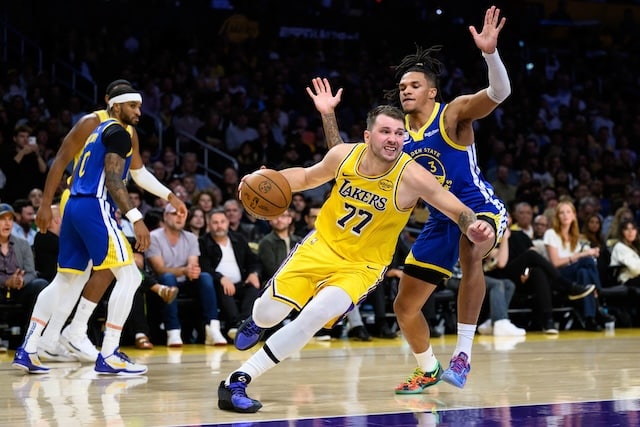
The 2025-26 campaign began with a national showcase that also served as a stress test. On October 21, the Lakers hosted the Golden State Warriors on opening night and fell 119-109, slipping to 0-1 while revealing both strengths and weaknesses that have defined their season since.
Luka Dončić opened his first full season in purple and gold with a massive scoring night, pouring in 43 points in a losing effort. He controlled the offense for long stretches, attacked mismatches, and repeatedly punished single coverage, but his high-usage night also underscored how much the Lakers leaned on him when the offense bogged down. Time and again, late-clock possessions turned into step-back threes and drives from Dončić as the Warriors sent different looks but rarely forced the ball fully out of his hands.
LeBron James missed the opener with a back issue, putting even more on Dončić and Reaves. Reaves responded with an efficient, aggressive performance as the secondary creator, getting into the lane, drawing contact, and spacing the floor when he played off the ball. His ability to toggle between roles allowed Redick to keep at least one primary playmaker on the court at all times, but the Warriors’ depth and shot-making eventually created separation in the second half.
Golden State’s perimeter shooting and pace stressed the Lakers’ transition defense and communication in space. The Warriors consistently generated clean looks from beyond the arc and forced Los Angeles into scramble situations, especially when they went small and dragged Ayton away from the rim. The Lakers’ size advantage did not fully translate into rebounds or points in the paint, and they never quite found the defensive rhythm needed to tilt the game.
The loss extended a difficult pattern on opening night. Over the last two decades, the Lakers have posted a losing record in season openers, with most recent years marked by slow starts against contenders and playoff-caliber opponents. Even in games where their stars put up big numbers—like Doncic’s 43 in 2025—Los Angeles has often come up short when it comes to closing runs, late-game stops, and execution in high-leverage possessions.
Current Form, Roster And Identity
By April 1, the Lakers’ roster has settled into a clear rotation. Dončić remains the focal point, leveraging his size and vision to orchestrate the half-court offense and punish switches, while making the midseason trade for Anthony Davis look worse for the Mavericks. LeBron, at 41, has shifted more into a selective, high-impact offensive role, picking his spots as a scorer while handling key defensive assignments and late-game decision-making. Their combination of playmaking and size remains one of the league’s toughest matchups when both are healthy.
Austin Reaves has solidified himself as the connector, toggling between on-ball and off-ball roles and providing secondary scoring, spot-up shooting, and late-clock creation. Deandre Ayton anchors the middle, giving Los Angeles rebounding, rim protection, and a consistent option in the mid-post and pick-and-roll. Rui Hachimura and Jarred Vanderbilt supply frontcourt versatility, while shooters like Luke Kennard and Dalton Knecht stretch defenses and give Redick flexibility with lineups.
Redick’s staff has leaned into versatility. The Lakers switch more actions on the perimeter, mix in zone looks, and rely on Ayton and Maxi Kleber to keep the paint organized. Offensively, they try to keep two creators on the floor at all times, often pairing Dončić with Reaves or LeBron with bench guards to maintain structure and pace.
Odds To Win The 2026 NBA Championship
ScoreBet currently prices the Lakers as a credible but not dominant championship contender. Their odds sit behind the league’s clear front-runners but ahead of teams that remain long shots, reflecting a team with a high ceiling, Hall of Fame-level star power, and a track record of adjusting over the course of a season.
Those odds are shaped by several factors. The Lakers sit in the top half of the West but remain in a tight cluster of teams separated by only a few games in the loss column. Their net rating and clutch performance numbers have improved compared to some recent seasons, but late-game execution still swings between sharp and sloppy. Health also matters, with LeBron’s workload, Dončić’s usage, and the durability of their supporting cast under constant scrutiny.
For bettors, the number captures both risk and potential. On one hand, few teams can roll out a closing lineup with as much skill and size as Los Angeles. On the other hand, the Lakers must prove they can string together four playoff series without the defensive letdowns and offensive droughts that have appeared at times this year.
Opening Night History And What It Means
The defeat to Golden State on opening night continued a long-term trend of uneven starts. The Lakers’ opening-night record over the last 20 years is below .500, with only a handful of seasons featuring statement wins out of the gate. Even in seasons that ended in deep playoff runs or strong finishes, the first game has often exposed issues that took weeks or months to iron out.
The 2024 opener against the Minnesota Timberwolves broke a decade-long drought, highlighted by the historic debut of LeBron and Bronny James as the first father-son duo to share the floor in an NBA game. That night offered a rare feel-good opening chapter. The 2025 meeting with the Warriors, by contrast, served as a reminder that early-season games can double as measuring sticks and warning signs.
For Redick and his staff, the message from opening night into April has been consistent. The Lakers know they have the top-end talent to compete for a title, but the margin for error is thin. Their path from inconsistent opener to legitimate contender runs through sharper defense against elite offenses, cleaner late-game execution, and an ability to protect home court against both contenders and lottery teams.