



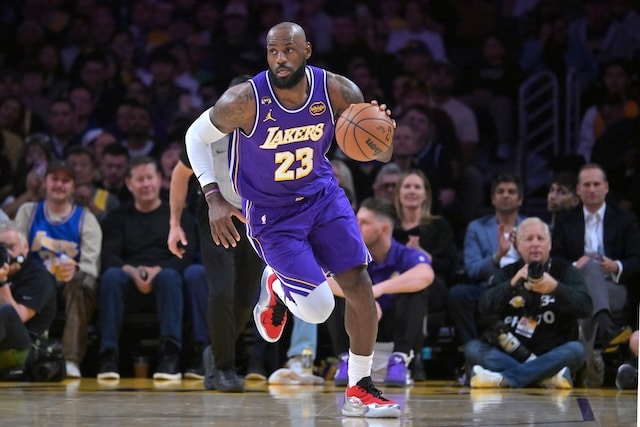
The Pattern: Close Score, Same Late-Game Mistakes
Despite sitting 12 games over .500, the Lakers remain in a precarious statistical position with a net rating of -0.7, which feeds fan anxiety that most wins are too close and too volatile. The team has a best-in-league type swing from overall Net Rating to Clutch Net Rating, but living off a massive positive clutch swing invites variance instead of banking reliable edges over 48 minutes. Recent games against long, rangy teams like the Suns, who use length and wingspan to shrink passing lanes even without tight pressure, and breakdown-heavy nights against teams like the Magic, highlight how fragile the closing process is. Every close loss also gets hammered by the informal “Lakers Tax,” where one possession late can dominate the narrative and feel louder than an entire game of solid stretches.
What “Late-Game Execution” Really Means
Late-game execution is not just “who has the best players,” it is what happens on each possession, normalized for pace and context. Modern possession-based analysis compares outcomes per possession, so teams playing at different speeds can be graded fairly, which is especially important in the final minutes when every trip down the floor is magnified. In those moments, teams benefit from very clear goals and predefined decision rules that function like a cockpit checklist, reducing critical late-game mistakes. Fans who track matchup context and late-game trends on sites like 7bet, looking at how closing issues affect expectations from game to game, are essentially trying to quantify how often those rules hold up. At the tactical level, it comes down to the Four Factors of Basketball Success—shooting efficiency, turnover rate, rebounding, and free throws—because the best teams rely on those pillars to close games and reduce randomness.
For the Lakers, the gap between their overall Net Rating and their Clutch Net Rating is the difference between their floor and ceiling, and it points to volatility in their execution. Late in games, the shot diet becomes predictable, with star skill sets replicating each other rather than complementing each other, while everyone else drifts into freelancing. The culture leans more toward free-form isolation from two or three stars than toward a consistent system, which often pushes James into inefficient corner usage while the offense tilts toward a James Harden–style, heliocentric diet for Dončić. This resembles the old back-to-the-basket inefficiency problem: isolations take too long to set up, giving defenses extra time to load up and rotate. There is also a need for functional spacing rather than just launching deep threes every trip; spacing should force defenders to stay attached to shooters who can fire in one second, thereby creating traffic and confusion in defensive rotations.
When the possession diet is fast-hitting but difficult and low-efficiency, built around solo artists, the offense fails to fully leverage the easy looks that gravity and passing can generate. Turnovers and “empty trips” in this context are even more damaging in the final four minutes, when turnover rate becomes a huge slice of the outcome pie in the Four Factors framework. The current rotation choices amplify this risk, as some lineups—such as the Dončić–Smart–LaRavia–James–Ayton group—run a poor turnover percentage around 12.1%, bleeding possessions without even producing shots. The deeper root problem is the Skill vs. Usage tradeoff, where spiking Usage% among primary ballhandlers late in games often leads to a drop in skill efficiency, along with more turnovers and mental errors under pressure.
Reducing Empty Trips
Reducing empty trips requires the group to commit to specific offensive habits instead of just more talent. Swing–swing passing has to be a staple to beat modern weak-side rotations and create clean, open looks instead of late-clock isolations into crowds. Offensive rebounding needs discipline because timely crash decisions create easy reset opportunities against defenses that are still in rotation and scramble mode. Roles should be simplified so high-usage stars are not repeatedly forced to dribble out the clock against set double teams, which usually leads to traps, panic passes, and live-ball turnovers.
Defensively, the main breakdown is that point-of-attack defenders struggle to contain the first action of the possession, especially against dribble penetration. When Dončić and Reaves get beaten off the bounce, the Lakers’ defense immediately shifts into emergency scramble mode, forcing helpers like James to cheat off shooters to protect the rim. This is especially dangerous because corner threes are among the most valuable shots in the NBA, routinely generating well over one point per shot and often hovering around 1.1–1.2 points per possession for quality corner looks. Once the ball is driven and kicked to the corner, that efficiency level can swing a single-possession game.
The underlying cognitive error is attentional tunneling, as defenders drift toward the middle, trying to “cover everything” and end up abandoning the optimal assignment. A better, more game-theoretic approach is a clear, polarized plan on each possession: either stay home on the corner shooter with strict rules that limit over-help, or fully commit extra help to the drive with a predefined rotation behind it. The in-between approach, where a defender is stuck halfway and then late to both jobs, almost always concedes a high-value corner three at the worst possible moment.
The Two Fixes (And Why They’re Hard)
Fix 1: Elite ATO Execution
The Lakers are genuinely elite coming out of timeouts, ranking in the top tier with roughly 1.17 points per possession on after-timeout plays, which is a strong offensive efficiency benchmark. The problem is extending that quality beyond the scripted possession, maintaining the same structure on subsequent trips when the action is no longer called directly from the sideline. There is also an asymmetric information issue: calling a timeout in a tie game can help the defense more than the offense, as it lets them set their matchups and coverage. The key is to use quick-hitting offensive packages that naturally flow into second and third-option plays if the first action is taken away, preventing the stagnation that often follows a well-drawn but single-layer ATO.
Fix 2: Net Positive Closing Lineup
There is growing optimism among analytics-minded observers that the team’s positive overall Net Rating is not being fully realized by the closing lineups. The most promising solution is to change the closing personnel to a lineup like Dončić–Smart–Hachimura–Ayton–Reaves, which has posted a dominant net rating in closing sample minutes over the past year. Another wrinkle is inserting Jaxson Hayes in select matchups for an energy spike, where small samples show a massive on/off net rating punch. Rotationally, however, making those changes is difficult; removing or minimizing James in a closing group, even for specific situations, becomes a political earthquake in the locker room and can destabilize the perceived hierarchy.
How to Watch This Like a Coach (Fan Checklist)
For fans trying to watch this like a coach, these late-game qualitative micro-adjustments should sit atop the usual box score and analytics habits. When you watch a close game, track the movement between shooters and defenders off the ball, especially in the corners, and see whether corner defenders stay anchored or habitually drift into the lane. Ask whether each possession forces a defensive rotation or just swings the ball around the perimeter; the best possessions involve a drive or cut that forces help and then a kick to create a 4-on-3 advantage, not just endless passes above the break.
On defense, look specifically for whether the Lakers concede corner threes, and focus your eye on the primary helper: if that defender gets stuck in no-man’s land, the possession is usually lost. After timeouts, evaluate whether the team generates a real shot within the flow of the play or ends with a bailout heave; that is the simplest practical test of whether the huddle was effective. Also pay attention to the off-ball defensive impact: who is tagging rollers, who is timing their digs at drivers, and who is providing early rim protection even if it never shows up in a standard box score.
The Bottom Line: Fixable, But Only With Intent
Fixing late-game execution is about aggregating marginal gains, not finding a single magic closing play. Improving spacing discipline, rotation timing, and role clarity by even a small percentage each game compounds over the course of a season. The Lakers are stuck in a Plateau of Latent Potential, where the work is in place, but the easy wins have not fully materialized yet. If they can adopt a consistent identity as a disciplined closing team, one that pressures the Four Factors, protects against corner threes, and trims empty trips, they become a legitimately nightmarish playoff matchup that can close out anyone in a seven-game series.