


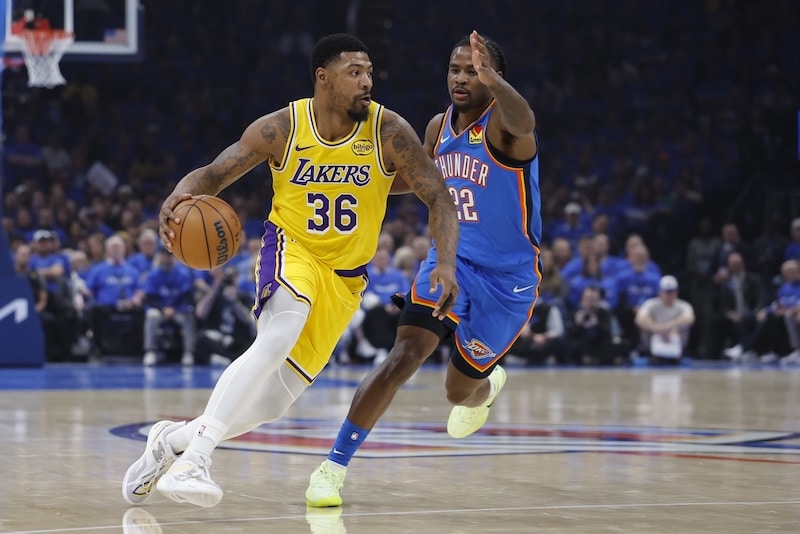
The Los Angeles Lakers entered the 2026 offseason focused on improving depth and maintaining flexibility for another championship push. That plan shifted when veteran guard Marcus Smart declined his player option, tested free agency, and ultimately signed with the Houston Rockets.
Smart’s move quickly became one of the early inflection points of the offseason. It removed a proven defensive option from the Lakers’ board and forced the front office to pivot. It also clarified the market for veteran guards and shaped how contenders approach roster balance ahead of training camp.
Championship odds continue to evolve across the league. GGBet currently has the Lakers at +3200 to win the NBA championship entering the 2026-27 season, with the general range across major sportsbooks between +3000 and +3500.
Smart Lands With Houston
Smart’s agreement with the Rockets gives Houston a defensive anchor in the backcourt. The former Defensive Player of the Year brings toughness, communication, and playoff experience to a young team looking to take the next step in the Western Conference.
He averaged 10.6 points, 4.3 assists, and 1.5 steals last season while continuing to guard multiple positions. His offensive numbers rarely define his value. Teams rely on him to set the tone, disrupt opposing guards, and organize defensive coverages in high-pressure moments.
Houston’s interest signals a clear intent to accelerate its timeline. Adding Smart alongside its developing core provides structure and accountability. It also gives the Rockets a veteran capable of handling late-game defensive assignments against elite Western Conference guards.
Impact On The Lakers
For the Los Angeles Lakers, Smart’s decision closes one potential path while opening others. The team loses the opportunity to add a guard known for physical defense and leadership, two traits that often define postseason success.
Head coach JJ Redick has emphasized spacing, pace, and decision-making since taking over. While Smart’s defense would have fit any system, the Lakers now have more flexibility to target players who better align with Redick’s offensive priorities.
The front office must now weigh how to redistribute resources. Options include pursuing perimeter shooting, adding another secondary ball handler, or strengthening wing depth. Each path carries trade-offs, especially in a competitive Western Conference where roster margins remain thin.
The absence of Smart also places more pressure on internal development. Guards already on the roster will need to absorb tougher defensive assignments and maintain consistency over a full season.
Defense Still Defines Contenders
Recent playoff runs have reinforced a simple truth. Teams that defend at a high level in the postseason give themselves a chance to win any series.
Smart built his career on that principle. His ability to switch, contest without fouling, and anticipate actions made him valuable even on nights when his shot was not falling. Those qualities do not appear easily on the open market.
The Lakers must now identify alternative ways to maintain defensive integrity. That could come from scheme adjustments under Redick, a committee approach among guards, or a separate acquisition later in free agency or via trade.
Defense does not always drive headlines in July. It often determines outcomes in May and June.
What Comes Next For Los Angeles
The offseason remains fluid. The Lakers are expected to stay active as the market develops, particularly as contract demands settle and trade opportunities emerge.
Front offices across the league often wait for the first wave of signings to pass before making calculated moves. The Lakers are in a position to do the same. Preserving cap flexibility allows them to respond quickly if a target becomes available.
There is also the possibility of revisiting needs as training camp approaches. Veteran players frequently remain unsigned as the offseason progresses, creating value opportunities for teams that stay patient.
For now, the Lakers shift focus. Smart is no longer an option. The goal remains unchanged. Build a roster capable of competing at the highest level in the Western Conference and sustaining that level deep into the playoffs.